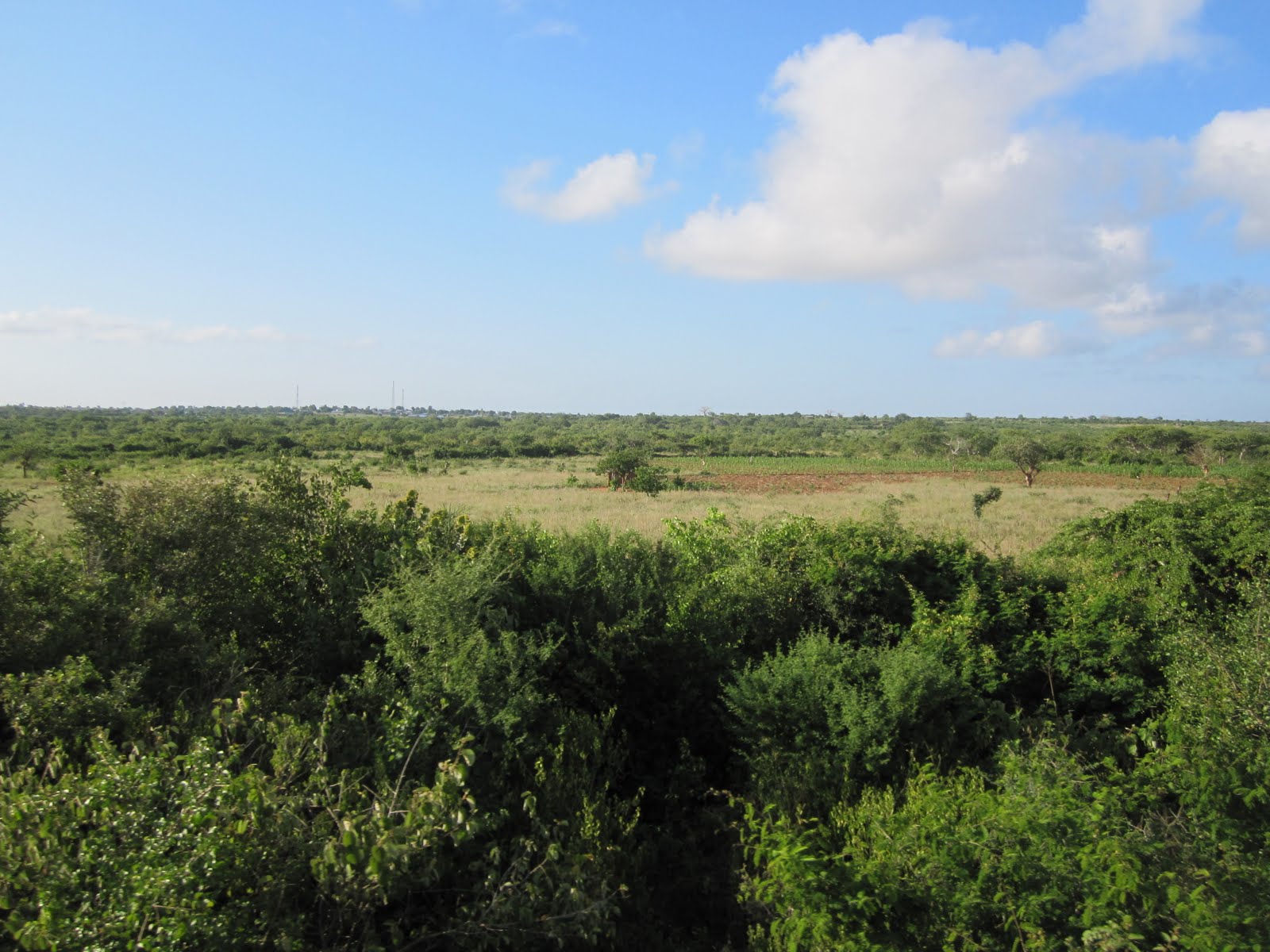
Friday, May 6, 2011

The Night Train to Mombasa


I visited Nairobi, Kenya in December, 2010. I was nervous about visiting Nairobi, nicknamed “Night-robbery,” because of its terrible reputation for being a dangerous city. In the end, however, my curiosity overruled any concerns I had for my safety and I simply had to see East Africa's largest and most dynamic city.
I arrived in Nairobi on a Tuesday afternoon from Juba. I spent the night at the Flora Guest House near the main hospital and close to downtown. The Flora had been recommended to me by a friend of a friend who had lived in Kenya for several years. The Guest House was great! Clean, quiet and set within a Roman Catholic religious community, it was populated by guests who were seeking the same quiet evening's rest as was I. Also, coming from Sudan, I was beside myself with pleasure at being able to have running hot water in the shower! Such luxuries are rare in Sudan. I was like a kid playing with the hot water dial, turning it up and down and giggling – literally giggling – at being able to enjoy a hot shower.
Contrary to what I expected, I found Nairobi to be a welcoming, fascinating city and not at all the Hell on Earth I expected from the descriptions of other writers (especially Paul Theroux, my favorite author but something of a curmudgeon. I read Theroux to find out how bad a place might be and then expect my actual experience to be somewhat better.) During my day I visited Isak Dineson's home, a high priority and something which I enjoyed greatly. At the insistence of my driver, Jacob – a very good fellow and the ideal way to visit Nairobi. If anyone needs a great driver, contact me! - I also visited a couple of wildlife sanctuaries, one for baby elephants and one for giraffes. These places were fine, but my main interests during my one day in Nairobi were experiencing enough of the city to make a judgment about it and visiting the Kenyan Railway Museum. I finally got to the latter sometime in the afternoon.
The Kenyan Railway Museum is located near the main train station in the heart of downtown. Like most train stations located in large cities the area around the train station had seen better days and at first glance seemed a little on the rough side. But I experienced no trouble during my visit. The Museum is housed in a large former railway shed and contains a first rate collection of artifacts covering all aspects of the development of railways in East Africa. This is not the place to discuss in detail the Museum, but suffice it to say that it is definitely worth a visit if you are interested in trains and how they effected the development of Kenya, Uganda and Tanzania.
I had made my reservation for a berth on the night train from Nairobi to Mombasa earlier via email with a Kenyan travel agent through a link from the Kenyan Railways' web site. I booked a first class ticket which entitled me to a berth in a two-berth room complete with a wash basin. Also, by booking first class I received dinner and breakfast the next morning. My ticket cost around $70-US dollars, a bargain considering that an air flight covering the same distance cost around $400. Instead, I got a nice bed, two great meals and the time and leisure of seeing eastern Kenyan at ground level.
At the the ticket office at the main Nairobi station I picket-up my ticket and was told to wait for about an hour until the train was ready to board. This was around 5-o'clock in the evening and the station was absolutely packed with locals cramming onto trains after a day's work in the city. I waited in a corner of the waiting room enjoying the ever pleasant pastime of people watching. It didn't take much imagination to figure out whom my traveling companions would be: safari-clothed Europeans or scroungy, jeans and t-shirt wearing Americans and euro-trash.
The train was due to leave around 7:05pm, but by 6:30 I had not yet heard any announcement, so I went out and walked up and down the platform by the long train which was positioned on the first track. I walked up and down a portion of the train looking for anyone I could ask but saw no one who looked like they knew anything. In fact, just the opposite occurred – I was approached by a young American who was traveling with his mother and who asked if I knew what was going on. I said no but as it was getting close to when we should be leaving we needed to figure things out quickly. Walking back towards the heart of the length of train cars (there must have been two-dozen cars at least making-up the train) we found a porter waiting by one of the car-doors who told us that this indeed was the overnight train to Mombasa and welcomed us aboard.
I had a minor panic – I'd been carrying my ticket in the same pocket inside my suit jacket where I always carry my papers but just before this moment when the young fellow asked me about the train I'd taken my ticket out to look at it and absentmindedly put it back in a different pocket. The porter asked me for my ticket and suddenly crap!, “where's my freeking ticket??” In a panic I rummaged through all my pockets and in the last pocket finally found my ticket and was able to board! Disaster averted!
My berth was cozy and I was lucky to be the only passenger to enjoy it, being spared the misery of getting an awful roommate (although, as this was a voyage of discovery I also missed-out on the opportunity to have someone with whom to compare notes which could have been great.) I was on car 2015, berth C. The equipment was British-built, circa 1960's and ran upon the British built meter-gauge rail line from Nairobi to Mombasa overnight. Returning westwards the train travels more during the day so you get to see more of Kenya, including through some of the animal preserves near Nairobi.
Our train left Nairobi five minutes late. Nairobi is at elevation 5453-feet above sea level (which made for quite a chilly morning when I awoke that day, the first cold I had felt in more than half a year.) The ride was smooth and comfortable upon the jointed rail. It was interesting to see that Kenyan Railways still used semaphore signals, something the US had mostly phased out a half-century ago. Still, no sense replacing what works and everything seemed to run perfectly well upon my journey.
I'd hoped to have the choice of which seating I would have for dinner, wanting to go to the second so I didn't feel rushed to vacate my seat, but unfortunately I was automatically assigned to the first seating. Dinner was served in a proper dining car with linen table cloths, heavy cutlery and courses served by waiters sporting jackets and ties. I sat with two young scruffy Danish guys. One was living in Dar es Salaam and seemed to be a professional student, the other was his buddy who was visiting Africa for a month.
Dinner was a really good Spanish-style dish, chicken cooked in lots of vegetables and herbs and served with rice. Before that we'd had soup and a salad (what a treat to eat salad since I normally have to avoid fresh veggies unless we prepare them), and after the main course we had cake. The food was well prepared and expertly served.
I was reading Nadine Gordimer's novel Burger's Daughter at the time and after dinner, after writing-up my trip notes I enjoyed the quiet and the gentle swaying of the train to read. I found the novel well written even if the story wasn't terribly engaging. Difficult as it is to find English language books where I live, next time I'm in a big city I'll have to try and find more Gordimer to see if I can continue to admire her skill as a writer but with a different story.
As happens when you are sitting in a lighted space and peering out into the darkness the night is a void, a shapeless, detail-less space. But when I turned out the light around 10pm to go to bed the outside world became alive thanks to the three-quarters full moon which shone brightly upon the Kenyan landscape. I dropped the screen covering the window and pressed my face to the edge of the darkness, standing a full hour watching Kenya pass by. I could see mountains and wilderness, and every now and then a light demarcating a small hamlet.
Occasionally we would stop, apparently just waiting for a clear signal because the waits were never long, more inconvenience, really. But evidently the locals know of these places where the train stops because in every seemingly desolate place where the train would stop I could see in the moonlit darkness people, children mainly, standing looking expectantly towards the train. As I would witness the next morning, it's quite customary for passengers to throw sweets to the local children along the line and the fact that it was nearing mid-night was no exception! Sorry for these children but I had no sweets with me, not even any biscuits to offer.
Sleep that night was good, a little difficult but that's mainly due to my own idiosyncrasies of having difficulty always of sleeping in a new place. I sometimes find travel tiring because I'm always uncomfortable sleeping in strange places, which is basically what traveling entails, doesn't it? But I managed to sleep until dawn the next morning when I awoke eager to again spend hours watching Kenya pass by my window.
Waking, I immediately went to look out the window and caught a glimpse of dawn breaking over eastern Kenya, the sky orangery-red near the horizon while as yet dark above. The landscape out my window when I awoke was fairly flat and had the feel, to me, of being near the ocean. I knew we were heading towards Mombasa which is on the Indian Ocean and so thought that we were near the coast and that our ride would too soon be over. But actually we were little more than half-way to Mombasa, it's just that eastern Kenya is a land of great variation in its topography: flat and sandy one moment, steep and hilly the next.
I prepared myself and enjoyed a proper English breakfast: a fried egg, sausages, bacon and thick sliced toast with butter and jam. My only deviation was in preferring fresh brewed coffee over tea. What joy to enjoy real milk in my coffee as opposed to powdered milk like in Sudan! I sat with a Kenyan lady named Valentine who actually lived in the US and was home visiting. With her were two of her young cousins while her elderly mother remained in their berth. Valentine had been living in the US for many years on a “student” visa. I think she occasionally took a course but mainly just worked. It hardly seemed the time or place to mention that people that live and work in our country while supposedly students infuriates many Americans. Still, Valentine was charming and we enjoyed a nice meal together.
Returning to my berth I dropped the window-screen and poked my head-out (in total violation of the rules.) I wasn't the only one, all along the length of the train I could see people doing likewise as we enjoyed seeing Kenya pass by. The landscape was gently rolling lightly green hills dotted with small scale farms and mud tukels, the look of east Africa. All along, everywhere, no matter how remote, would be waving children hoping for a sweet to be tossed to them. The train passes by about once a day, and it was sad to see children from a distance running for all they were worth knowing they would never reach the tracks in time to even hope to beg for a sweet. Oh well, better luck tomorrow. It actually made me uncomfortable watching the children begging and then scrambling like animals for whatever was tossed their way. The psychology of giving and begging becomes complicated and confusing in these situations. I had nothing to give and so just watched the spectacle in silence.
There were still a number of old stations along the line complete with adjacent signal towers. The controls for switches and signals were controlled manually by a station agent. Large levers were connected to signals via thin metal wires using pulleys where necessary. A station agent could sit in his signal tower and control the aspect of signals a tenth of a mile away or more.
The Railway still used paper train orders which were handed up to the crews of of passing trains using train order hoops. I'd only read about such operations in history books – what a treat to still see a railway being run using such methods! I was experiencing railroading from a generation or two before my time. How wonderful it is to step out of our one's own world-frame and see the world through different eyes and experience how others live.
Onwards we continued and although we were nearing Mombasa the topography belied the fact that the ocean was not far away. We passed through steep hills and I could see a deep river gorge a distance away. We even traversed one loop around a mountain-top wherein we passed over and then under ourselves as the train lost elevation on our rush to the sea.
Closer we came to Mombasa and when we got about 20-miles out suddenly signs of urbanization appeared as we began to pass industrial areas and many homes and people. Near Mombasa there is a small private rail line which serves a chemical plant and we saw an engine and some tank cars from this operation – wonderful for a train spotter like me.
The amount of urbanization became complete and soon there were people and houses and buildings everywhere. The city center loomed ahead at one point as we descended downwards and I could see the skyscrapers. By this point I was feeling rather sad that my trip would soon end, so pleasant had been the journey. Some friends that had taken the trip before said they'd been left sitting a long time owing to equipment failures, something to which I wouldn't have entirely objected. But my trip was almost perfect, we would arrive only a short time late, not enough to even bother about.
Mombasa station is at elevation 18-meters, around 58-feet. We'd dropped around 5400-feet elevation coming from Nairobi to Mombasa and you could feel it. Mombasa was hot and humid, and upon entering the city it seemed chaotic, noisier and dirtier than Nairobi. I decided rather quickly that I preferred Nairobi. Mombasa also has a strong Muslim population and this was evident in the architecture and character of the city. I saw many women dressed in bhurkas, only their eyes being revealed. Down by the waterfront was a warren of narrow alleyways and interesting buildings with elaborately carved doorways and shops selling African junk to tourists. Away from the water the city just seemed like a hustling, bustling center of commerce, an Atlanta or Omaha in a different setting.
I had a day to kill in Mombasa before traveling on to Zanzibar via cruise ship. When you are alone and visiting a place lacking in charm or attractions a day can seem like an eternity. But the night train from Nairobi to Mombasa is an excellent adventure, well worth the modest cost. Next time I'll have to bring bags of candies for the children.

Wednesday, April 6, 2011

Re-Upping

It has been nearly a year since I first came to Sudan. I think somewhere around the 10th of May will mark my actually anniversary date. It would be almost impossible to convey into words all of the amazing experiences I have had since being here, though I will try my best to do so. The Sudan has been unlike anything I have ever imagined, for both good and bad. I thought that I had stepped back in times years ago when I visited Cuba, but that was nothing like arriving in Sudan. It's actually quite weird: In many ways people are living here much like they probably have for centuries - maybe loner - especially when you venture out into the countryside. I remember standing looking over the Nile River in Malakal recently, looking at the peasant farmers tending their small plots along the fertile riverbank thinking that little had probably changed there in several thousand years. And yet nearly everyone here has a cell-phone and lusts for a car and a big-screen television! It's like living in a half stone-age/half space-age world.
I came to Sudan because I felt called by God to share my gifts of education and experience with people that needed help in the areas of finance and administration. There is no question that I have been able to call upon every bit of knowledge and experience I have ever had since being here, the demands upon my time and energy have been enormous. But so, too, have been the satisfactions of seeing people learn and acquire new skills and abilities knowing that I helped them to accomplish these things. It is truly wonderful.
Anyway, I do not believe my work here is done. Partly that's because I have found myself so busy most of the time that I am not always able to focus upon the longer range tasks which I should be doing: there is simply not enough time in the day. So, I have prayed about it and decided that I should remain here one more year, that that will allow me the time to accomplish more of what I think God wants me to do.

Friday, February 11, 2011

The Gleaners

Amidst the general chaos that exists in Juba right now owing to all of the building and construction projects, one of the roads that I use almost daily to walk to and from the office has been completely rebuilt and the other day was finally tarmaced. This is remarkable for many reasons, the least of which is that this quarter-mile long stretch of asphalt measurably increases the amount of tarmaced road in all of south Sudan. I used to enjoy walking on this road when it was just a dirt path and you had to cross a small stream by straddling an old truck chassis that someone had thoughtfully laid across the water. I was a little sad when the road was widened and scraped and the neem trees which grew-up in the middle of the right-of-way were cut down. This used to be a quiet pathway but once it was widened and gravelled it became a busy, dusty thoroughfare. But that's progress. Finally last week the construction crew came in and laid down the last layer of gravel and paved the road. No sooner had the road-crew left, I think actually before they left, a small group of women showed-up and started retrieving the excess gravel which had been left on the edges of the road. All this week the women have been there, from first light in the morning until evening. Bent over all day, exposed to the sun and the terrible heat that we are currently experiencing (close to or over 100-degrees every day), digging with their hands through the gray dirt to sift out the precious gravel which they collect in large pails. When their pails are overflowing the women then lift them with practiced dexterity and a strength that would shame most men and pour the gravel into large sacks. When full the sacks are tied closed and left to be sold to whomever it is that comes around and buys sacks of recycled gravel. It is hideous, brutal work. At first I felt sorry for the women having to do this work, working so hard for probably very little. There is an entire industry here of gravel making that is conducted by women. On the south side of town there is a camp of women, like outcasts, who toil all day with hammers to break down boulders into gravels of various sizes. There is so much construction going on in Juba, such a demand for gravel, that the women are always busy and fill an valuable role. This is one of those cases where an unthinking, kind hearted person might be tempted to bring in a large mechanical gravel making machine so these women didn't have to do such hard work. But the net result of that action would be to put a large number of women out of work and to saddle the local economy with another machine which would spend more time broken down. In Africa, labor is cheap and plentiful and in need to occupation. The western desire to provide people here with great pieces of machinery usually result in disaster, putting people out of work and leaving them dealing with equipment which frequently breaks and for which parts are difficult if not impossible to find. Anyway, getting back to the rock ladies, at first I felt bad seeing these women digging through the dirt all day for bucketsfull of gravel. But a friend pointed out how entreprenurial these women were, taking advantage of an opportunity and that if they weren't getting the gravel someone else would. Far from being pitiable, I have began to see these women as smart and strong and remarkable and wishing them the best of luck. It's funny how things are not always how they seem at first.

Friday, November 26, 2010

Malaria...Again!!

Several weeks ago I went to a music concert on a Saturday night. I felt somewhat ill, with a splitting headache. The next day I felt largely the same, and rather tired. I wasn't sure if it was actual illness or exhaustion, since I'd been working long hours every day getting ready for a major meeting. But I spoke with a doctor friend after services Sunday morning who advised that I go to a local clinic and get tested for malaria as soon as possible. The next morning I went to the clinic where they drew a drop of blood (they make just a small prick on your finger to put a drop of blood on a glass slide. I assumed they'd take a vial and thus wore a short-sleeved shirt.) After reviewing the slide I was informed by the doctor that I indeed had malaria! I was expecting some sort of near death experience, but really malaria was rather disappointing as illnesses go, just a bad headache and a mild fever. Still, it's best not to take chances with a disease which kills millions every year, so I'm glad I got tested right away and got on medication. In Africa, in Sudan at least, you don't need a prescription to walk into any pharmacy and order whatever you like. "You want malaria medicine?, step right-up." "You'd like something with opium to soothe your nerves? Got just what you need." And the prices are so cheap. You can get a big box of pills for 10-pounds, the equivalent of $4.00. If there was any kind of postal system it would be quite lucrative buying medicines here and shipping them back to the US for resale. Anyway, after three days I felt better - not one hundred percent - but better. A friend gave me some of her SP pills, another standard malaria drug. After that I felt better, and when I returned to the clinic on Friday to be retested they said I was malaria-free.
Last week I spent five days in Aweil, up in Northern Bar-el Ghazal state. The area around Aweil is flat as a sheet of paper and prone to flooding, since the water doesn't have anywhere to go. The area was mosquito-ey (is that a word?) and the hotel we used lacked mosquito nets for the beds (however, they had monkeys running around - a fair trade-off I thought.) I know the first night that I heard mosquitoes buzzing around me and I awoke covered with bites. Conditions in the hotel improved and we were able to keep our room mosquito free the rest of the nights, but the damage was done. Shortly after we returned from Aweil I started feeling ill, and I recognized the symptoms. A quick trip to the clinic confirmed the presence of malaria - but "scanty" according to the technician who read the slide. Speaking of the technician, I had a fun time tormenting him as only I can. When he retrieved something from the mini-fridge in the lab room I asked him if he kept his lunch in there. He said "no," but did own-up to keeping waters and sodas in the fridge. Before reading the slide the technician dips the slide in four cups of different colored dyes, the process of which is supposed to make the malaria bugs stand out making them easier to see. I pointed out how in America at Easter we place eggs in cups of dye just like he had in order to dye eggs for children (I don't think he believed me.) By this point the technician, I could tell, was thinking that malaria was the least of my problems and mental illness was more likely present. But the best part was after he had looked at the slide through the microscope. I asked the technician if he'd ever looked at something through the microscope that scared him so much he'd wanted to run out of the room. I figured he'd just say, "no," but he excitedly said "YES!" then he went on to tell me how when he had first started how he had looked at a stool sample on a slide to check for worms and when he did the worms looked so large and they looked like they were coming right-up at him. By now I had practically fallen out of the chair I was laughing so hard. It was great. I knew this guy was happy too to have finally been able to share that event with someone who could appreciate it (for the comic moment it was, IMHO.)
After the test I saw the doctor who informed me I had a mild case of malaria. He prescribed a different medicine, although he was sure that this was a new infection rather than a relapse of the old case - whatever. The doctor explained that I would need to take the medicine with fatty foods. I just looked at him for a moment and then told him, "If you weren't a man I would kiss you." I told him he was the doctor I'd been looking for all of my life! The next morning I made sure to buy a bag of fresh lumps of dough fried in grease - Juba doughnuts - thinking to myself as I munched these greasy treats: Doctor's orders.
I have nearly finished my course of meds and I'm feeling better now. I think abother part of the problem is that I switched anti-malarial medications. I used to take Malarone, which worked great, but after running out switched to Doxycycline. There is evidently some resistence by malaria to Doxy, I've known several people that were taking it who got malaria anyway. But at least the treatment is easily available and cheap, and hopefully I won't need it again.

Saturday, October 9, 2010

Jogging in Juba

Thirteen months after being forced to quit running owing to a terrible injury to my left achilles tendon, after thirteen months of boredom and falling out of shape and gaining weight, I recently was able to take-up jogging again here in Juba.
I say jogging because my achilles tendon, which was injured when I foolishly decided to add a “hill workout” to my running routine as I was training for the Ashland Half-Marathon last August, is still a bit tender and not really one-hundred percent. But I am so sick and tired of not being able to run that I am cautiously tempting fate by running at a seriously reduced pace which thus far, it's been three weeks, seems not to be causing my left heel any problems and even seems to be helping a bit.
I added the “hill workout” after reading the annual Runner's World guide to half-marathons. In it they give all sorts of training advice. But, I didn't think to introduce the routine into my workout gradually. Given my “all or nothing” personality, I simply decided one day to pound up a huge hill ten times. As with injuries caused by overuse, like hard gardening on a Saturday, I didn't feel anything at the time. But the next morning (what happens while we are sleeping that causes our bodies to fall apart?) my left heel was in agony. Thinking that I just needed to “stretch it out” I keep running for a few more days until the pain became unbearable. After doing a little on-line research I found information about something called “achilles tendonosis” that seemed to match my symptoms. The information also said if I didn't stop running immediately I risked causing a permanent injury that would preclude me from ever being able to run again. So, I figured a few months of rest was better than a lifetime of inactivity.
But the injury was stubborn. Every morning for the better part of a year I would wake-up and find the same pain, the same stiffness in my left heel. Stretching, the normal antidote to most running injuries, did nothing and, in fact, seemed only to make matters worse. Eventually I decided to just quit worrying and just let time heal my heel.
And, eventually, things did improve, in spite of moving overseas to a town where I mostly walk everywhere, though rarely more than a mile or two at any given time. But Juba is a town made for running. Mostly flat, with mainly dirt roads, and normally warm which precludes having to wear sweats and hats and gloves like back home, Juba is a great place to jog.
Once I was certain my left heal could take a little abuse, I started out cautiously lightly jogging about a half mile loop from the Guest House grounds to the MAF compound, up to the paved Juba-town road and back to the Guest House. I knew, thanks to all the walking I do, that I had the aerobic capacity to run a little, but would my heel hold? Unlike my normal seven-minute mile pace I was plodding along at ten-minute miles, or slower, but I was jogging! And so long as I didn't try and go too fast or strike the ground too hard I was able to jog along at a measured pace almost indefinitely. In fact, it's been only three weeks and I'm already up to covering jogs of five miles or so without causing any harm to my heel!
Almost the only people that jog in Juba are ex-Pats, the European and American folks working for the innumerable NGO's (non-governmental organizations) that litter south Sudan. There are all sorts of folks here, the well meaning save the world do-gooders, the grizzled embittered “got no where else to go” people, the people that have figured out how to make a lucrative living off the generous “overseas, hardship” pay plus per diems and car and housing allowances, and some folks that have absolutely no business being here at all. But except for the current crop of police recruits who are forced to jog all over Juba on Saturday mornings, and the odd soccer team that occasionally takes to the streets, the only people seen jogging on a regular basis are kwagas, the local word for “whites.”
Adult Africans, when presented with something they don't understand, simply laugh in response. And so, when I'm jogging about town, I often hear adults break out into roars of laughter at seeing what to them is a crazy white man going jogging past. Part of the laughter stems from the extreme practicality of Sudanese, especially the men. If a Sudanese has a job for which he is being paid he will work at it very hard, not even minding working seven days a week. But, if he is not being paid, then a Sudanese sees no purpose to stirring himself no matter what. Other than the observation that if you hire a Sudanese to do a job its best to hire him on a project by project basis, it's also understandable that to a Sudanese, someone out debasing himself by expending energy on something like jogging for which he is not being paid is more than bizzare, it's downright hysterical.
Case in point: In almost every case whenever I am coming back from my late afternoon/early evening run, I pass by Bishop Gwynne College. BGC is a project of the Episcopal Church, a theological college with aspirations of being much more. In the evening a number of the students, all but one of whom are adult men ranging in age from early twenties to upper fifties, can be found sitting out on on the road in front of the College, enjoying the evening. And when I jog past every time it causes the men there to burst into laughter. It's been three weeks and the men find it still as funny as the first time.
But, whereas the adults might find the sight of a white man running through the streets nothing less than hysterical, the children of Juba find it downright wonderful. The children here are normally fascinated by kwagas anyway, squealing out their “good mornings” to you as you go past their homes. But add in the spectre of a running kwaga and the appeal becomes irresistable. Never a time I'm out running does it not come to pass that I won't have a gaggle of little children running along behind me squealing with laughter, and yelling out “kwaga” and “good morning” with more delight than usual. It's always the same thing, just young children, from toddlers to no more than about seven or eight years old, at which point some internal switch seems to activate which makes such behaviour no longer seemly or “cool.” But the little ones have no such self-consciousness which gives them the freedom to act with such pure abandon.
The other great thing about jogging in Juba is the ability it gives you to really get a feel for the town. In fact, one of the main reasons I wanted to take-up jogging again was to be able to see more of the town in a much more time efficient manner. It's been interesting to get to see up close some of the neighborhoods as I've explored the back roads. Security is not a problem. Firt of all, the Sudanese are too busy laughing at me to think of causing me any harm. Secondly, since I'm only wearing running shorts and a t-shirt it's obvious to anyone that I haven't got anything worth having on me. And I think the fact that I'm out jogging also pre-supposes to the Sudanese that I'm mentally unfit enough for anyone to be willing to pay much ransome to get me back, in case that scheme ever occurred to anyone. Fortunately, that whole business of kidnapping people as a form of raising cash has not started here in Sudan like it has in places like Somalia or El Salvador.
I'm hoping after a while to be in enough shape to really be able to jog all over town. There's no better way to get to know a town than to walk around it, or jog around it, in this case. I am thus far thankful that I've been able to return to the one sport that I absolutely cherish and I hope that my running experiences here will be long lasting and wonderful.

Sunday, July 11, 2010

Habits

In their person, the Sudanese are a remarkably fastidious people. In the city, at least, the majority of people always dress like they are on their way to Sunday services. Their clothes are neat, crisply pressed, and quite stylish. In fact, one of the first prejudices a visitor must overcome is the idea that people who live in mud-brick tukels must by the same token appear unkempt. Nothing could be further from the truth. In mud-brick tukels people may live, largely because so many have only recently returned to Sudan since peace was declared a few years ago and housing options are limited, but that does not mean that locals cannot be neat and clean and have pride in their appearance. What was it Dinesen said about pride? “It is faith in the idea that God had when he made us.” And thus, the Sudanese take great pains to make sure their clothes are always clean and that they remain so throughout the day. I have seem men arrive at construction sites dressed more nicely than am I who is on his way to an office. The difference is that by the end of the day I somehow am splattered with mud while the Sudanese remains clean. A large part of that is the deliberate and careful way in which the Sudanese carry themselves. They are a most graceful people, their movements almost choreographed. They are never rushed, never haphazard, but thoughtful in their actions. I, on the other hand, have always been ackward and have always attracted dirt and dust and in a land where people largely succeed in remaining clean I stand-out the greater for my failure to do likewise. As if to emphasize their habit for cleanliness, the Sudanese, where water is available, will take two showers daily, in the morning and evening.
As a kawaga (literally “foreigner,” though it is a name applied almost exclusively to whites) I attract a lot of attention, though not for my nature, but for my wardrobe and appearance. It is from teenage girls, the arbiters of taste no matter the locale, from whom I receive the hardest and most intense looks as they examine every inch of my appearance. And it is from the same group from whom I receive the most scornful looks for what they perceive to be my less than attractive appearance. In my pressed long sleeve shirts (I have my laundry done at the Guest House and the ladies there press my clothes quite crisply using charcoal-heated irons) rumpled khakis and – worst of all - my Clark's desert boots which are hopelessly stained from the dust of Africa compared with the always well shined shoes worn by native males, I am afraid that I present a less than ideal image compared with the Sudanese.
Of course, these observations apply most directly to people living in Juba. People living in the countryside who, as do country dwellers everywhere, live closer to the land, try though they might to be clean and stylish, inevitably pick-up more dirt in their daily movements than do city dwellers. So, too, are country dwellers more relaxed in some of their other habits. In Juba, the act of relieving oneself in public is limited to males. It is not uncommon to see men all over town with some modesty relieving themselves. But in the country, or along the roadways, both men and women can be observed in this act – again, expercising some discretion in their movements.
Many habits are shared by men and women. Spitting knows no seperation of the sexes and the only difference where the uncommon practice of smoking is observed – uncommon because poverty mercifully keeps the practice rather at bay – is that women are more likely to use delicate pipes rather than smoke the cigarettes favored by men.
It is important to backtrack for a moment with regards to the comment about how men that are engaged in construction work finish their day less dirty than do I. This is not to imply that the Sudanese do not work hard. If they have a job to do the Sudanese, men and women, are a very hard working people, working six and seven days a week if need be. By the same token, if they do not have a job the Sudanese can hardly be induced to stir and are apt to remain sitting in the ubiquitous plastic chairs in the shade all day. Sudanese see no reason to waste effort needlessly.
In practice, Sudan is largely a male dominated society. When you see couples walking along the men always lead, the women following a few paces behind, and in terms of feeding and most other actions the men always come first. I have never been to a private dinner where the men were not fed first with the women having to be content with the remains. I understand, too, that in legal matters the courts tend to favor men and certainly where a couple divorces the children always go to the man. This is somewhat ironic given my observation that the women of Sudan do most of the work and are carrying this country on their backs – or, more accurately, their heads if you've ever seen the enormous loads women here are capable of carrying upon their heads. Besides the usual big pots of grain or bundles of firewood or jerry-cans of water that women regularly carry, the heaviest load I have yet seen a woman carry on her head was the woman – a middle aged woman, no less - on the road to Terekeka, who had a kilometer or more ahead of her before reaching town and who knows how long she had already walked, who had upon her head one of the body sized bags of charcoal, an object heavier than I can hardly even lift. The art of learning to carry upon their heads starts early for girls. Certainly by the age of five or so girls are beginning to practice walking deliberately, ramrod upright and transporting small pots or bags of grain. As their size increases so does their carrying capacity along with their skill. While out for a stroll in Rumbek I loped behind two teenage girls each of whom had upon her head a large bag of grain while between them they kicked along a large rock as they walked and talked. Impressive indeed, and a genuine source of pride. I have tried to imagine American women walking from grocery stores or malls with budles piled-up on their heads, their hands free to operate cell-phones or reach for a set of keys or to hold a child's hand. Obviously, it is a skill which cannot be picked-up late in life. The skill and strength of neck muscles required must be started early in life in order for the practice to be successful. But it is interesting to see women walking around, even in a large city like Juba, gracefully upright and walking ever so deliberately, a legacy perhaps of a childhood spent learning how to carry large bundles upon their heads.
Perhaps the one maddening habit of the Sudanese is their impatience when facing a que, or line. Instinctively, the Sudanese will all bunch towards the front and are never shy about cutting in front of a line to try and be first. This happens whether taking tea or at the bank or, most dangerous of all, while driving. At all times upon the roads except for the largest and slowest vehicles, all other vehicles are forever jockeying for position and never hesitating to pass each other. Two lane roads are often converted into four lane roads as vehicles rush to pass one another, either two in opposite directions or even two passing one going in the same direction. At intersections, which at the largest locations are roundabouts, vehicles all cram forward until almost no one can go owing to the jam-up. I often marvel at this degree of impatience and the consequential delays it creates, even in so simple an act as taking tea. Rather than form an orderly que in which each takes his turn, the Sudanese will cram forward until they are a mass of elbows and knees and no one can get their shai. One keeps hoping that they will see the error of their ways, but so long as each person thinks that they will be the one to get through more quickly by their actions, so it will continue. Fascinating people.

Monday, June 28, 2010

Greetings and such.

There is nothing more important to the Sudanese than personal relationships. Their friendships, their associations with others – these are key to understanding the Sudanese. I was sharply reminded of this a few weeks ago. There is a retired bishop that has been living for some time at the Guest House. One evening an old childhood friend of the bishop's that is now working for a government ministry stopped by for a visit. I had the pleasure of meeting the bishop's friend and spending some minutes talking with these gentlemen. And as I was taking my leave I said to the friend, in a typical breezy American style of something you say without really thinking about it, “See you, and if I can ever help you, give me a call.” The friend was aghast. “Oh, no,” he said, “We do not know each other well enough for us to consider talking business. We must meet several more times, get to know each other better, before we can discuss business.” Chastened, I replied that he was, of course, correct and that I would enjoy seeing him again.
It may seem maddening to a westerner how much time the Sudanese spend sitting around in plastic chairs under shade trees just talking and doing, to our minds, precious little. But it is all part of the social fabric here, it is how relationships are forged, connections made, news transmitted and ideas discussed. And for a society which still is ruled by tribal considerations and who you know is far more important than what you know, the strength of these social connections is what governs how society functions. And it is because of how deep these associations and friendships run that explains why Sudanese greet each other so warmly, with genuine affection, in rituals which convey all kinds of meaning. Though a real Sudanese might laugh at my misunderstandings, I have observed the following styles of greetings during my time here.
Shakinghands is the most important ritual performed by the Sudanese. Whenever you meet someone or you see someone you know you are expected to stop whatever your doing and shake hands. It doesn't matter if you've already shaken hands with these people already today. It doesn't matter if you just shook hands with these people five minutes ago. If they visit you in your office, or you visit them in theirs, you are expected once again to shake hands. Doing less is considered offensive. Also, if you meet someone out and you have a few minutes of conversation, it is not uncommon as each of you makes a point or as you share a laugh or bit of news that you might shake hands again...and again. It is also not uncommon – and this primarily for men rather than women – to see people of the same sex walking hand in hand. It is meant as a sign of friendly or brotherly affection, nothing more. Although I see this somewhat in Juba, this practice is much more common in the countryside. When I spent a weekend in Terakeka I probably observed more than two dozen instances of men walking around hand in hand. The Sudanese would be offended beyond belief if anyone suggested that such behavior had a sexual component, being as they are rather homophobic in general. No, it is a sign of friendship and one I've had to become used to myself as I've had my hand held by men at times.
When two Sudanese with a good regard for each other meet – where there has been some time between meetings – they will first place their right hands on each other's left shoulders, or tap their friend's left shoulder, before shaking hands and/or embracing. A more elaborate hand shake in such an instance might involve the regular shake, then a shake wherein thumbs are gripped, and then back to a regular shake. It is a variant of the style of handshakes that used to be practiced in Afrcan-American communities back in the 1970's and '80's. A less intense means of a person showing affection or respect for the person whose hand they are shaking might be to grip the other person's hand with two hands.
When a person wishes to show great deference to the person whose hand he is shaking – and this can occur because of any number of social or economic disparities between people – the person showing the deference will shake hands with their right hand but place their left hand on their right forearm, maybe six-inches or so up from their wrist. I've also seen people do this, for example, at church during free-will offerings. The person making the offering will hold their outstretched right arm with their left hand six-inches up from the wrist. In that case they might even bow slightly.
A variation of this in reverse is when you've already got your hand out to greet someone, the person you're greeting might offer you their right forearm for you to touch rather than offer their hand. But I've also seen this done during mealtimes. Since the Sudanese – real Sudanese, anyway – eat primarily with their hands, if you meet someone while their hands are soiled with food they will likely offer you their right forearm to touch. The washing of hands before and after meals is an ingrained, lovely public ritual which visitors quickly come to appreciate. It shortly becomes second nature to you to expect to wash hands before and after every meal to where it will be difficult not to enjoy this public ritual upon returning home.
The Sudanese are a lovely, gracious people, with impeccable manners. In their speech, in their deportment, they are never less than courteous. I've never heard anyone use vulgar or salacious language, I've never even heard anyone curse. It is a refreshing change from America. And though I have not discounted the possibility that people are behaving this way since there is an outsider around, I have observed the Sudanese often enough in their private moments to think they are like this most of the time. Lovely people.